
Nuclear fission is a fundamental process in nuclear physics that has transformed the way humans produce energy. It is the reaction responsible for generating electricity in nuclear power plants and also forms the basis of atomic weapons. Despite its immense power, nuclear fission is carefully controlled in many applications to ensure safety and efficiency. This article explores nuclear fission in detail, including its definition, process, types, uses, advantages, and disadvantages.
What is Nuclear Fission?
Nuclear fission is the process in which the nucleus of a heavy atom splits into two or more smaller nuclei, along with the release of a large amount of energy. This reaction usually occurs when a heavy nucleus is bombarded with a neutron.
A commonly used example of fission involves uranium-235, a radioactive isotope. When it absorbs a neutron, it becomes unstable and splits into smaller atoms, releasing energy, additional neutrons, and radiation.
The Discovery of Nuclear Fission
Nuclear fission was first discovered in 1938 by German scientists Otto Hahn and Fritz Strassmann. The theoretical explanation of the process was later provided by Lise Meitner and Otto Frisch. This discovery marked a turning point in science and led to the development of nuclear energy and weapons.
How Nuclear Fission Works
The process of nuclear fission can be explained in simple steps:
- A neutron collides with a heavy nucleus (such as uranium-235).
- The nucleus becomes unstable and splits into two smaller nuclei (called fission fragments).
- A large amount of energy is released in the form of heat and radiation.
- Additional neutrons are emitted.
- These neutrons can trigger further fission reactions, leading to a chain reaction.
Chain Reaction
A chain reaction occurs when the neutrons released during fission cause additional fission events. This can happen in two ways:
- Controlled chain reaction: Occurs in nuclear reactors, where the reaction is carefully managed to produce energy.
- Uncontrolled chain reaction: Occurs in nuclear weapons, leading to massive explosions.
Types of Nuclear Fission
1. Spontaneous Fission
This type occurs naturally without external influence. It is rare and happens in very heavy elements.
2. Induced Fission
This occurs when a nucleus absorbs a neutron and becomes unstable, leading to fission. It is the most common type used in nuclear reactors.
Applications of Nuclear Fission
1. Electricity Generation
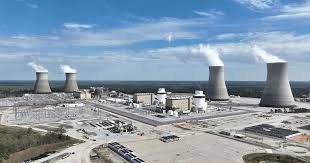
Nuclear fission is widely used in nuclear power plants to produce electricity. The heat generated from fission is used to produce steam, which drives turbines connected to generators.
2. Nuclear Weapons
Fission is the basis of atomic bombs. A well-known example is the bombing of Hiroshima during World War II.
3. Medical Applications
Radioisotopes produced through fission are used in medical diagnosis and cancer treatment.
4. Scientific Research
Fission reactions help scientists study nuclear structure and develop new technologies.
Advantages of Nuclear Fission
- High Energy Output: A small amount of fuel produces a large amount of energy.
- Low Greenhouse Gas Emissions: Nuclear power plants emit very little carbon dioxide.
- Reliable Energy Source: Provides continuous power unlike solar or wind energy.
Disadvantages of Nuclear Fission
- Radioactive Waste: Produces hazardous waste that remains dangerous for thousands of years.
- Risk of Accidents: Nuclear disasters can have severe consequences.
- High Cost: Building and maintaining nuclear power plants is expensive.
- Weaponization: Can be used to create destructive weapons.
Nuclear Fission vs Nuclear Fusion
Nuclear fission should not be confused with nuclear fusion:
- Fission: Splitting of a heavy nucleus.
- Fusion: Combining of light nuclei to form a heavier nucleus.
Fusion releases even more energy than fission but is more difficult to control and is still under development for large-scale energy production.
Safety Measures in Nuclear Fission
To ensure safe use of nuclear fission, strict safety measures are followed:
- Use of control rods to regulate the chain reaction
- Thick shielding to contain radiation
- Proper disposal of radioactive waste
- Continuous monitoring of reactor conditions
Conclusion
Nuclear fission is one of the most powerful and impactful scientific discoveries in human history. It has revolutionized energy production and contributed significantly to scientific advancement. However, its potential risks require careful handling and strict safety measures. As technology continues to evolve, nuclear fission remains a key component in the search for efficient and sustainable energy solutions.